

A house can look perfect on paper and still feel “off” once
it’s built. Floors bounce, doors stick, cracks show up, and suddenly the dream
home starts acting like it’s tired. This is where a structural engineer
earns their keep.
A structural engineer figures out how a building will stand
up, not just on day one, but year after year. That includes day-to-day weight,
strong winds, small ground shifts, and in some areas, earthquakes. The goal
isn’t fancy math for its own sake, it’s a home that feels solid and stays that
way.
Good Structural Design starts with good information, not
guesses. When clients bring clear plans and real site details, the engineer can
make smart choices early, before the project locks in expensive mistakes.
What a Structural Engineer Really Does (and Why It Matters)
A structural engineer designs the “skeleton” that holds a
building together. That skeleton includes the foundation, columns, beams,
slabs, and structural walls. It’s the part no one posts on social media, but
it’s the part that keeps the home safe and comfortable.
At its core, Structural Design is about forces and paths.
Weight from people, furniture, and roofs has to travel through the structure
and into the ground. Wind tries to push walls sideways. Soil can settle in
uneven ways. Water can change soil behavior. A good engineer plans for these
realities so the building doesn’t fight itself over time.
This role also protects long-term value. A well-designed
structure helps prevent common headaches like sagging floors, cracked finishes,
and foundation movement that turns into costly repair work. It can also make
future changes easier, like opening up a wall for a renovation, because the
structural logic is clear and documented.
Clients sometimes assume the architect and structural
engineer do the same job. They don’t, and that’s a good thing. The architect
focuses on layout, light, flow, and how the building looks and works for daily
life. The structural engineer decides how that vision can be supported safely.
When both sides coordinate well, the result is a home that feels good and
behaves well.
Turning an Architect’s Plan into a Safe, Buildable Structure
Once an architectural plan exists, the engineer maps out the
load path. That means deciding where columns should sit, what beams are needed,
how thick slabs should be, and what type of foundation fits the site.
“Buildable” matters as much as “safe.” A design can be
strong on paper and still be hard to build on-site. The engineer chooses
details that contractors can actually set out, pour, and connect correctly.
Good detailing reduces rework and helps keep the job moving.
This is also where many future problems get avoided. Clear
beam sizing can prevent bouncy floors. Proper reinforcement and joint details
can reduce cracks. A foundation matched to the soil can stop uneven settling
that later shows up as wall cracks and stuck windows.
Working with the Whole Team (architect, contractor, MEP)
Structural work touches everything. Stair openings,
skylights, water tanks, ducts, and plumbing all cut through the structure in
some way. If these parts aren’t coordinated, the site crew ends up drilling
holes in the wrong place or shifting walls late in the game.
A structural engineer coordinates with the architect and the
MEP team (mechanical, electrical, and plumbing) so openings land where the
structure can handle them. They also respond to contractor questions, which can
be as simple as confirming a bar size or as serious as stopping an unsafe field
change.
Site visits, even limited ones, help catch issues early. A
quick clarification during construction can prevent a mistake that’s expensive
to undo after concrete has cured.
The Structural Design Process Clients Will Actually Experience
Most clients don’t experience Structural Design as a single
“big reveal.” It’s a set of steps, and each one depends on the quality of the
inputs. The first contact often starts with a design query, such as, “Can this
plan work with an open living room?” or “Can the building support a future
extra floor?” Better questions lead to clearer answers and fewer surprises.
After that first discussion, the engineer reviews the
architectural drawings and site details. If the plan is still changing weekly,
the engineer may suggest pausing major calculations until the layout settles.
That can save time and reduce redraw costs.
Once inputs are stable, the engineer begins framing options,
checks spans, and sets column and wall locations that make sense for both
structure and rooms. Then they design foundations and members based on the
expected loads and the soil report. If the project is in a high-wind area or a
seismic zone, those factors shape the layout and details too.
Time and money usually go into three places: (1) getting
reliable site and soil information, (2) producing clear drawings and
reinforcement details, and (3) revisions when the layout changes. Many projects
run smoothly when changes are made early and communicated clearly, before steel
and concrete quantities are locked.
Inputs Needed Before Design Starts (site details, soil
report, floor plan)
The basics the engineer typically needs include:
- Site location (for local code, wind, and seismic assumptions)
- Number of floors and any future expansion plans
- Architectural floor plan and elevations
- Span goals (large open rooms, fewer columns, wide openings)
- Preferred material system (reinforced concrete, steel, masonry, timber)
- Soil report timeline, or at least known site conditions
- Approximate square footage per floor
- A basic floor plan (even a marked-up sketch.
- Desired finish level (simple, mid-range, premium)
- Notes on basement, terrace, or roof tank
- Whether large openings or open-plan areas are planned
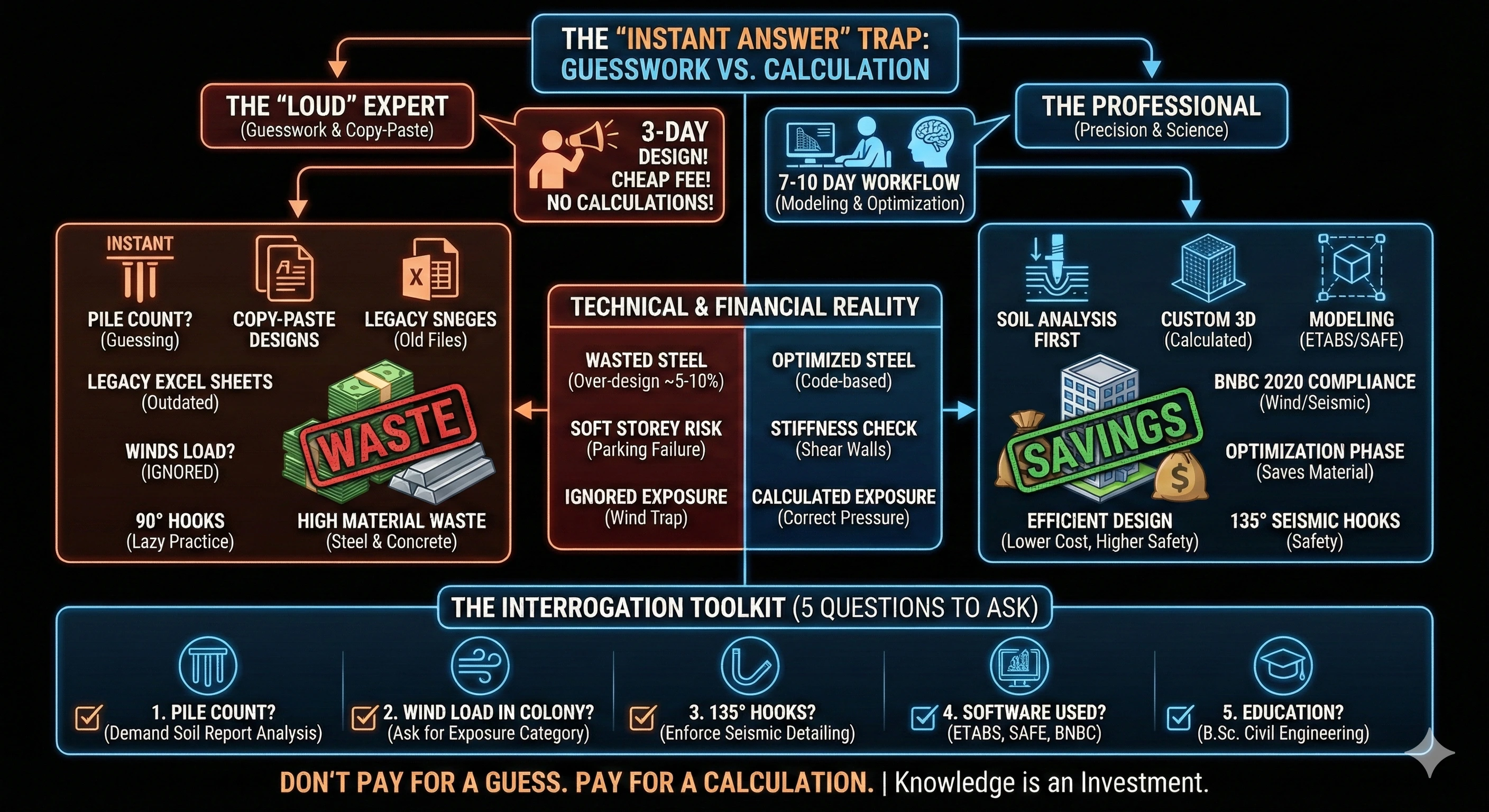
A soil test matters because the foundation “talks” directly
to the ground. If soil is soft, expansive, or filled, the foundation may need
to spread loads differently or reach deeper. Skipping the soil report is risky
because it forces guesses on the one part that’s hardest to fix later.
What Clients Get Back (drawings, notes, revisions, site support)
Clients usually receive structural drawings that show the
foundation plan, column and beam layout, slab details, and key notes on
materials and construction requirements. Many projects also include
reinforcement detailing (often called bar bending details) where it’s relevant
and expected by local practice.
Revisions are normal. If the architect shifts a staircase,
adds a larger window, or the client wants a bigger cantilevered balcony, the
structure may need updates. The best outcomes happen when changes are shared
quickly, not after the contractor has already ordered steel.
Site support often means answering contractor questions,
reviewing key stages (like foundation steel before pouring), and confirming
that what’s being built matches the intent of the drawings. That support keeps
small misunderstandings from turning into permanent defects.
Common Design Query Mistakes and “Stupid Questions” Engineers Hear (and the Smart Answers)
Some questions sound blunt, but they usually come from
stress and budget pressure. Most clients are trying to avoid getting
overcharged or making a bad decision. A good engineer treats these as common
misunderstandings and answers them in plain terms.
The bigger issue is that many questions skip the facts that
control the outcome. Structural Design can’t be priced or planned like buying a
fixed product off a shelf. It responds to the plan, the site, the soil, and the
local rules.
A helpful habit is to treat every design query like a short
checklist: What is being built, where is it, what is the soil like, and what is
the layout?
“What’s the cost of a 3-story building?” without plans or soil info
A three-story building could mean a narrow home on firm
ground, or a wide plan on weak soil with big open spans. Those are not the same
job.
Without size, layout, materials, location, and soil
conditions, any cost number is a guess. An engineer or contractor can offer
rough ranges, but only as a starting point.
A better way to ask is to share:
With that, early guidance becomes more useful and far less
misleading.
“Can you design without a soil test?” and “Can you reduce the cost?”
Designing without a soil test is like guessing number without
knowing the land area. The structure might stand, but the risk shifts to the
foundation, where mistakes get expensive fast. Soil affects footing size,
depth, and even the amount of steel and concrete needed.
Cost reduction is possible, but it has to be done safely.
Common levers that often help include:
Shorter spans: Breaking a large room span can reduce
beam sizes. Simpler shapes: Clean rectangles often cost less than
irregular plans. Aligned walls and columns: Stacking supports from floor
to floor saves material. Fewer late changes: Last-minute layout edits
trigger redraws and rework. Realistic cantilevers: Big overhangs look
nice but can drive up cost quickly.
Clients often ask for an estimated cost before design. A
ballpark can be discussed early, but the real savings usually come after proper
Structural Design, when the structure is optimized for the actual plan.
Conclusion
A structural engineer’s job is to turn a layout into a
building that feels solid, stays safe, and avoids nasty surprises later. Good
Structural Design supports comfort as much as strength, because a quiet, stable
home is easier to live in.
For a first design query, clients can speed things up by
sharing a basic plan, the site location, a soil report timeline (or existing
soil info), and clear goals like open spaces or future expansion. The simplest
next step is to book a consult or send a sketch for initial feedback, then
build the project on facts, not guesses.


Discussion
No comments yet. Be the first!